Possibilities of augmentative and alternative communication

What is augmentative and alternative communication (AAC)?
The aim of AAC is to improve the communication and participation of people who have difficulty understanding or no spoken language (see Braun 2020). Its methods include all educational and therapeutic aids that are offered to people without or with significantly impaired spoken language to help them understand and improve their communicative abilities (cf. Wilken, 2021).
What does this mean in practice?
AAC plays a central role in promoting participation and inclusion as defined by the International Classification of Functioning, Disability and Health (ICF). Through the various methods of AAC, children can compensate for their limited or missing spoken language in all areas of life and thus participate more actively in everyday life. They experience self-determination and participation.
Who is AAC for?
AAC is aimed at anyone whose active language skills are not sufficient to communicate fully with their environment and participate in everyday life, education and the world of work. This includes people of all ages with congenital or acquired speech and language impairments. The UK enables them to interact better with their environment.
How can AAC help?
AAC can be used for both short-term and long-term support. Examples of short-term support are
- Help with the language development of children
- Support for non-speaking people, e.g. after medical interventions
- etc.
- In the long term, AAC may be necessary for
- Motor impairments such as cerebral palsy
- Developmental disorders such as autism spectrum disorder (ASD)
- Disabilities such as Rett syndrome, etc.
In these cases, AAC can serve either as a substitute language or as a supplement to existing verbal communication.
The targeted use of AAC enables your child to express themselves better, thereby avoiding frustration and promoting linguistic, social and everyday participation. This is an important basis for school and vocational training.
Individual adaptation
The form of communication in augmentative and alternative communication (AAC) is chosen individually based on your child's abilities and needs. Whether symbols, simple aids or speech computers: AAC offers many ways to improve your child's communication skills and promote their participation in everyday life. The content of AAC can vary greatly depending on abilities and communicative goals, from the first attempts at making contact to complex communication using written language.
Flexible input methods
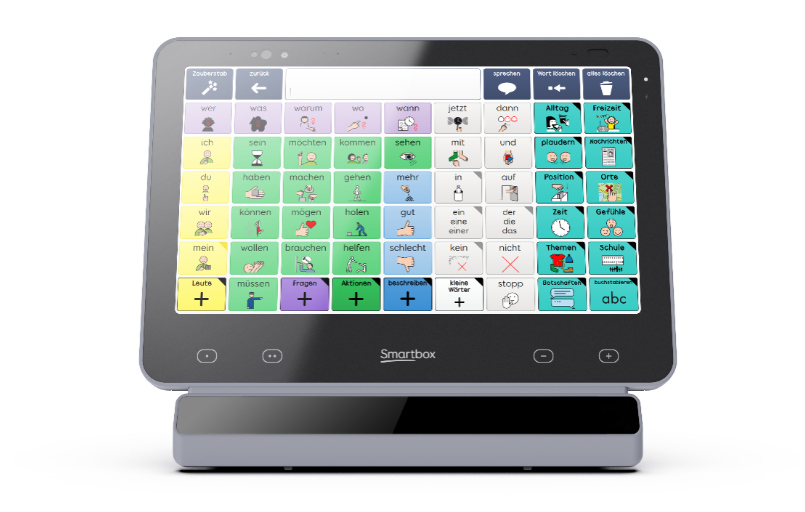
Grid Pad 13 with eye control
Does your child need a hearing aid? Then contact an aid company or an advice center to find the best aid for your child.
Support your child with the right communication aid

Talk Pad with Grid for iPad
The input methods are just as flexible and adapt to your child's motor skills. In addition to manual operation, there are various alternative control options such as scanning, eye control and mouse substitutes, including for PCs.
Important to know:
AAC aids are covered by statutory health insurance and do not fall within the budget of the prescribing doctor.