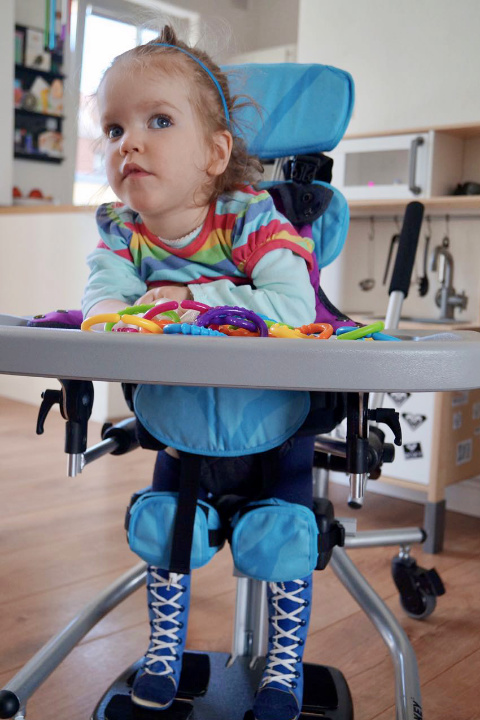
Standing training - the earlier, the better
The assistive technology market offers a wide range of standing trainers. These enable children and young people who are unable to stand independently to verticalize themselves safely.
The benefits of standing trainers are undisputed. On the one hand, standing supports participation in social life and communication, for example, and on the other, many positive effects on physical structures have also been demonstrated.
These include
- Support of bone and cartilage metabolism as well as joint development and thus prophylaxis of osteopenia/osteoporosis
- Tone regulation
- Increasing concentration and alertness
- Improvement of head, posture and trunk control
- Positive influence on the cardiovascular system as well as urological and gastrointestinal functions
- and much more.
In order to achieve these effects, children should stand for one hour at least five times a week according to current publications. Standing times should be increased according to the child's abilities (training effect).
Questions about the right time and the criteria for selecting the "right" standing trainer often lead to uncertainty.
The earlier, the better:
For children who are unable to stand up at the age of 12-18 months due to their underlying condition, care should be reviewed jointly in an interdisciplinary team with physiotherapists and/or occupational therapists and the responsible doctor. Devices are now available that can be adapted for young children.
Existing orthoses or insoles that stabilize or correct the feet, knee and hip joints can also be worn in the standing trainer.
A number of criteria influence the selection of the standing trainer and must be considered in advance: The current findings (contractures), the course of the disease in relation to possible adaptations (additional pads or head supports), and last but not least, acceptance are imperative to consider. As the standing trainers for adolescents are quite large and usually heavy, there should be enough space at the place of use. However, one of the most important criteria is the aim of the treatment.
In order to be able to keep track of the potpourri of aid manufacturers, a few principles of care should be known and taken into account accordingly.
Static standing frames/vertical standing frames
These are easy to use and provide support and stability. For example, the table enables (two-handed) handling while standing. By passively securing the legs and torso, they are also ideal for use in kindergarten or school because the child can concentrate on the activity of the hands. Both the generally heavy weight and rigidity are sometimes perceived as a hindrance.
Dynamic standing stands
To counteract this rigidity, more and more manufacturers are offering so-called dynamic standing trainers. These are unstable due to a "spring or rocking mechanism" and ensure reactive muscle tension. This makes them a very good training device for the torso and only suitable to a limited extent for concentrating on homework, for example. In most cases, it is possible to switch off the dynamics (e.g. by means of a lock) and use the standing trainer for this purpose.
Mobile standing frames / standing riders
These standing aids are equipped with large wheels that enable movement in a similar way to a wheelchair. This allows children to actively determine their range of movement and take part in everyday life. It is advisable to check the upper back and shoulders beforehand, as some children show an increased hunchback when pushing the wheels. Sufficient space at the place of use is a prerequisite in order to avoid frustration on the part of the children later on.
Inclined boards
A distinction must be made between so-called dorsal (child in supine position) and ventral (prone standing device). While the former are more suitable for children with a weakness in the front muscle chains, the dorsal ones are used to activate the back muscles. In principle, both offer a wide range of modification options, for example to accommodate contractures or increased hip abduction. Transfer is often possible directly from the care bed or using a lift. Children with severe disabilities in particular benefit greatly from being fitted with an inclined lying board.
For all standing trainers, it is generally recommended that an interdisciplinary target definition is carried out beforehand, followed by a test. Ideally, this should be carried out at the subsequent place of use by the people who will be using the standing trainer with the child. Together with experienced physiotherapists, occupational therapists and rehabilitation technicians, the right standing trainer can be found for every child!