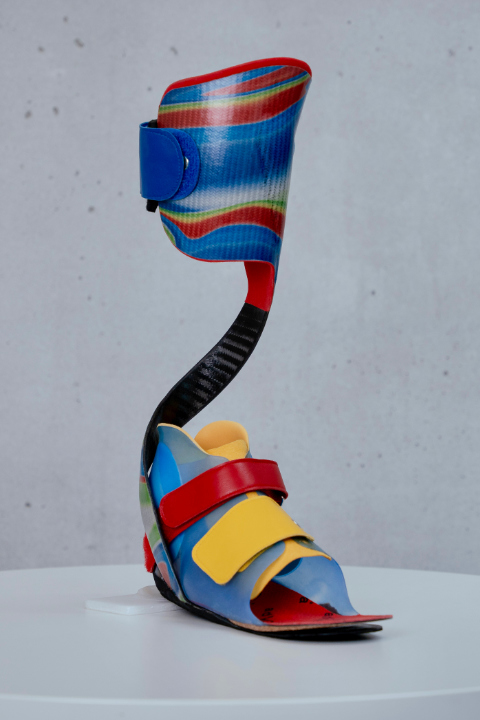
Spiral Orthoses – Lightweight, Functional, and Custom-Fitted
Spiral orthoses are a proven treatment solution when it comes to specifically improving gait while preserving as much natural movement as possible. Especially in cases of neurological disorders, they can make daily life significantly easier—provided they are properly selected and individually fitted.
What makes a spiral orthosis special?
Unlike rigid orthoses, the lower-leg spiral orthosis is characterized by its light weight and high flexibility. Movement in the ankle joint remains possible in both dorsiflexion and plantar flexion. As a result, physiological muscle activity—especially in the calf muscles—is not blocked but actively supported.
During the gait cycle, the spiral orthosis provides targeted support: During the roll-off phase, the swing phase is facilitated, the knee can bend more easily, and the foot lifts securely. At the end of the swing phase, controlled initial heel contact is supported—with the goal of bringing the gait pattern as close as possible to physiological movement.
Why a Precise Analysis Is So Important
To ensure that a spiral orthosis can achieve its full effect, a detailed gait analysis beforehand is particularly valuable. In our daily work, we use Orthelligent Vision for this purpose—an AI-based, markerless analysis method that objectively captures movement patterns in a way that reflects real-life conditions.
The data obtained provides important insights into gait patterns, joint movements, and stress distribution. These findings are directly incorporated into the biomechanical design and individual configuration of the Spiral Orthosis. The result is not a one-size-fits-all solution, but a custom orthosis precisely tailored to the specific gait issue.
What should you look for in a spiral orthosis?
1. Individual Analysis Before Fitting
A spiral orthosis should never be an “off-the-shelf” product. A comprehensive medical history—including muscle status, range of motion, and any contractures—is crucial to avoid improper fitting. If possible, a gait analysis provides valuable insights for the biomechanical design of the orthosis.
2. Understanding the appropriate indications
Spiral orthoses are particularly suitable for many neurological conditions where residual mobility is preserved. However, they reach their limits in cases of severe spasticity, significant contractures, or rigid deformities. In such cases, other orthotic systems may be more appropriate.
3. Check suitability for everyday use
A major advantage of the spiral orthosis is that it can often be worn in regular shoes. Make sure that shoes provide sufficient space and ensure a secure footing—this increases patient acceptance and the amount of time the orthosis is worn daily.
4. Take the adjustment period and feedback seriously
Even though spiral orthoses often feel lighter and less “foreign” than rigid orthoses, the body needs time to adjust. You should address pressure points, unsteadiness while walking, or unusual muscle reactions early on so that adjustments can be made.
My Practical Tip
A spiral orthosis is most effective when it is based on a thorough analysis and is regularly reviewed. Modern systems like Orthelligent Vision help us orthotists objectively evaluate movement and specifically optimize treatments—for greater safety, a more natural gait, and increased confidence when walking.