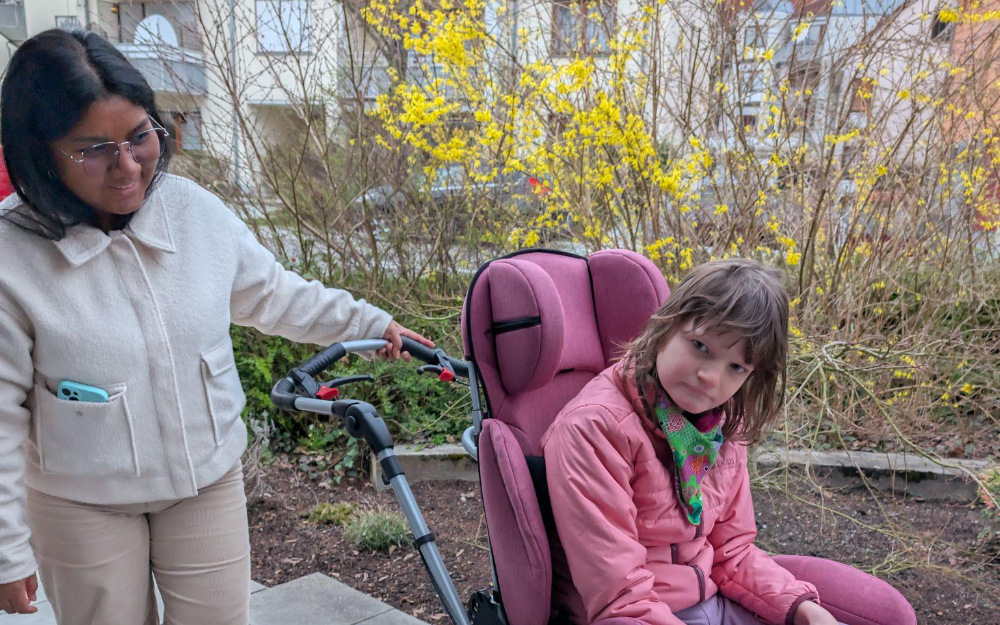
Au pair in everyday life
Support in inclusive family life
How an au pair enriches everyday life - also culturally.
Because there were always a lot of shortfalls in our childcare situation and the management of several mini-jobs, which are taken over by the social welfare office as a family relief measure, costs a lot of nerves and time, we have now decided to hire an au pair for the first time.
An au pair is practically another family member who comes to Germany to get to know our culture better. In return for being integrated into our family, the au pair does up to 30 hours of light housework a week.
Of course, this is only possible if you have an extra room available. In our family, Nike's big brother Leo is going abroad for a year, which is why his room is available.
There is another hurdle: Au pairs are not allowed to provide care, only care. You should also find an au pair who perhaps already has experience with children with disabilities.
Details on the conditions for au pairs
An au pair costs a total of around 500 EUR per month: 280 EUR pocket money, insurance, public transportation card, language course support and agency placement fee. As an au pair is also a cheaper solution for the social welfare office than various mini-jobbers, the social welfare office has agreed to cover the costs.
Most au pairs are placed in the summer months - ideal if they start before the cold winter and the start of a new school year. This makes it easier for them to find an apprenticeship in Germany afterwards.
Through our community, we have found an agency that specializes in finding au pairs for children with disabilities: Au Pair Agency Special Stars.
After an initial interview, we were given a profile and access to the database, which we used to search for and contact suitable au pairs. Contact was usually made directly via WhatsApp. We learned that you have to be quick, because good au pairs don't stay in the database for long and find families quickly.
After several conversations, we decided on a young woman from Africa. As soon as she receives her visa, she will be part of our family.
Now it's up to us to make her year here meaningful for everyone. Having lived with a family in the USA for a year myself as a 15-year-old, I know that there are big cultural hurdles at the beginning: Living in a different country, with a foreign culture, language and without people you know is a challenge. That's why we thought about what could be particularly different and important. Here are a few ideas:
Everyday life & household
- Waste separation: paper, plastic, residual waste, organic waste, glass - very important and sometimes confusing in Germany.
- Punctuality: Appointments and everyday life are very time-structured.
- Household appliances: Dishwasher, washing machine, induction stove, coffee machine - a patient introduction helps.
- Water and energy consumption: Take short showers, switch off lights, ventilate windows instead of tilting them.
- Operating aids: Lifts, care bed, electric wheelchair, communication devices - it is best to explain in detail and, if necessary, create short videos that can be watched again and again.
Care & education
- Educational style: Participation and communication are very important. Corporal punishment is prohibited. Children are often allowed to participate in decision-making and express their feelings.
- Daily routines: Fixed sleeping, eating and playing times can deviate from the usual rhythm.
- Safety rules: Road traffic, child seat, crosswalk, bicycle helmet, secure windows, etc.
Orientation & mobility
- Bus and train travel: Buying tickets, reading timetables (apps such as DB Navigator or bwegt).
- Route to school, nursery or supermarket: Walk together and explain at the beginning.
- Show important places: Doctor's surgery, pharmacies, town hall, emergency numbers, post office, ATM etc.
Shopping & nutrition
- Opening hours: Stores often close early, everything is usually closed on Sundays.
- Food prices: Products such as fruit, rice or fish can be more expensive or different.
- Self-service: You are expected to pay and find your own way around.
- Eating habits: Bread for breakfast, cold dinner, few hot lunches - possibly unfamiliar.
Culture & society
- First and last names: Who is on first-name terms, who is on first-name terms?
- Privacy: Many people value distance and privacy.
- Racism/discrimination: Raise awareness and convey safety.
- Clothing & weather: Seasons, weather-appropriate clothing, onion look, shoes for indoors and outdoors.
Language & integration
- Language stimulation in everyday life: Talk to each other a lot, correct mistakes in a friendly manner, practise small everyday sentences.
- German courses: Register at VHS or other local language school.
- Facilitate contacts: Get to know other au pairs or communities from the home country.
Interpersonal relationships
- Build trust: Be patient, explain a lot, take questions seriously.
- Address cultural differences: Communicate lovingly, ask for understanding.
- Explain festivals and rituals: Christmas, St. Nicholas, Easter - communicate meaning and procedures.
A report by Constanze Werdermann
Conclusion
An au pair can be a valuable support in inclusive everyday family life - not only in practical terms, but also on a personal and cultural level. They take the strain out of everyday life, bring new perspectives and can become a real part of the family. At the same time, it takes openness, time and mutual understanding for this special coexistence to succeed for everyone.
Tips from the community:
Special stars
Besondere Sterne is a placement agency for families with children with disabilities. You should also bear in mind that you will have less privacy as there is always someone present.
Childcare with people from different cultures -
how everyone benefits
Because our childcare situation has always had major shortfalls and the management of several mini-jobbers, who are taken on by the social welfare office as a family relief measure, costs a lot of nerves and time, we have now decided to take on an au pair for the first time.
An au pair is practically another family member who comes to Germany to get to know our culture better. In return for being integrated into our family, the au pair does up to 30 hours of light housework a week.
Of course, this is only possible if you have an extra room available. In our family, Nike's big brother Leo is going abroad for a year, which is why his room is available.
There is another hurdle: Au pairs are not allowed to provide care, only supervision. You should also find an au pair who has experience with children with disabilities.
Details on the conditions for au pairs
An au pair costs a total of around EUR 500 per month: EUR 280 pocket money, insurance, public transportation card, language course support and agency placement fee. As an au pair is also a cheaper solution for the social welfare office than various mini-jobbers, the social welfare office has agreed to cover the costs.
Most au pairs are placed in the summer months - ideal if they start before the cold winter and the start of a new school year. This makes it easier for them to find an apprenticeship in Germany afterwards.
Through our community, we have found an agency that specializes in finding au pairs for children with disabilities: Au Pair Agency Special Stars.
After an initial interview, we were given a profile and access to the database, which we used to search for and contact suitable au pairs. Contact was usually made directly via WhatsApp. We learned that you have to be quick, because good au pairs don't stay in the database for long and find families quickly.
After several conversations, we decided on a young woman from Africa. As soon as she receives her visa, she will be part of our family.
Now it's up to us to make her year here meaningful for everyone. Having lived with a family in the USA for a year myself as a 15-year-old, I know that there are big cultural hurdles at the beginning: Living in a different country, with a foreign culture, language and without people you know is a challenge. That's why we thought about what could be particularly different and important. Here are a few ideas:
Everyday life & household
- Waste separation: paper, plastic, residual waste, organic waste, glass - very important and sometimes confusing in Germany.
- Punctuality: Appointments and everyday life are very time-structured.
- Household appliances: Dishwasher, washing machine, induction stove, coffee machine - a patient introduction helps.
- Water and energy consumption: Take short showers, switch off lights, ventilate windows instead of tilting them.
- Operating aids: Lifts, care bed, electric wheelchair, communication devices - it's best to explain in detail and, if necessary, create short videos that can be watched again and again.
Care & education
- Educational style: Participation and communication are very important. Corporal punishment is prohibited. Children are often allowed to participate in decision-making and express their feelings.
- Daily routines: Fixed sleeping, eating and playing times can deviate from the usual rhythm.
- Safety rules: Road traffic, child seat, crosswalk, bicycle helmet, secure windows, etc.
Orientation & mobility
- Bus and train travel: Buying tickets, reading timetables (apps such as DB Navigator or bwegt).
- Route to school, nursery or supermarket: Walk together and explain at the beginning.
- Show important places: Doctor's surgery, pharmacies, town hall, emergency numbers, post office, ATM etc.
Shopping & nutrition
- Opening hours: Stores often close early, everything is usually closed on Sundays.
- Food prices: Products such as fruit, rice or fish can be more expensive or different.
- Self-service: You are expected to pay and find your own way around.
- Eating habits: Bread for breakfast, cold dinner, few hot lunches - possibly unfamiliar.
Culture & society
- First and last names: Who is on first-name terms, who is on first-name terms?
- Privacy: Many people value distance and privacy.
- Racism/discrimination: Raise awareness and convey safety.
- Clothing & weather: Seasons, weather-appropriate clothing, onion look, shoes for indoors and outdoors.
Language & integration
- Language stimulation in everyday life: Talk to each other a lot, correct mistakes in a friendly manner, practise small everyday sentences.
- German courses: Register at VHS or other local language school.
- Facilitate contacts: Get to know other au pairs or communities from the home country.
Interpersonal relationships
- Build trust: Be patient, explain a lot, take questions seriously.
- Address cultural differences: Communicate lovingly, ask for understanding.
- Explain festivals and rituals: Christmas, St. Nicholas, Easter - communicate meaning and procedures.
A report by Constanze Werdermann
Do you have any other tips on how to make an au pair stay a success?