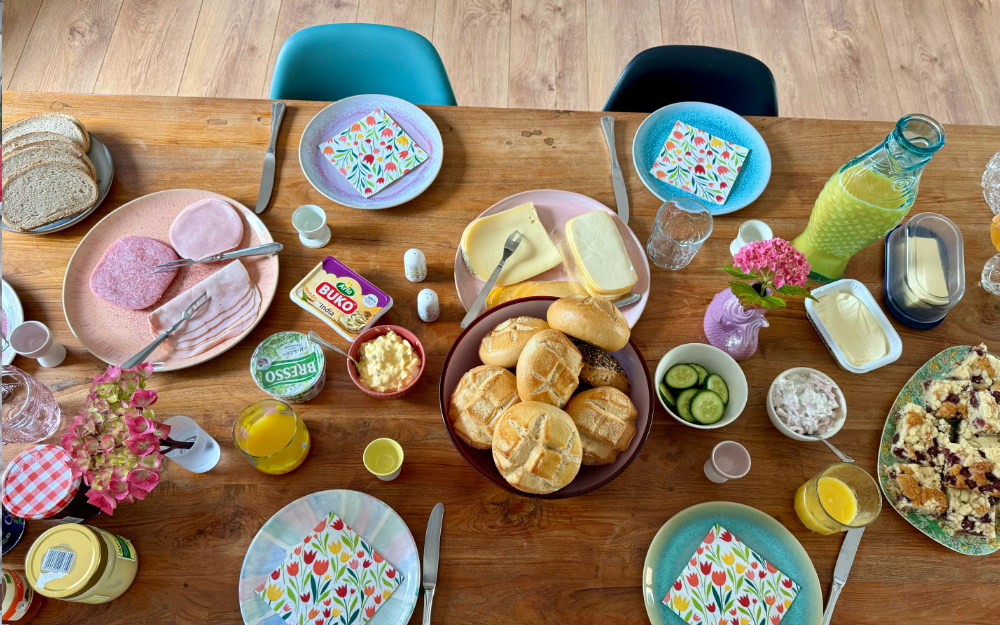
Shared meals
Eating as we are
Why a shared table means more than just a meal.
A table, a plate, a spoon - and a lot of courage. When children with disabilities learn to eat, it's about much more than food: it's about self-confidence, belonging and the courage to do things your own way. In the following article, we will show you ways in which eating with a child with a disability can be successful - with suitable aids, everyday tips and a lot of heart at the table.
When eating becomes an exercise
Many children with disabilities learn to eat more slowly or in a different way to their peers. This often begins with the introduction of solid food. Some children have difficulty chewing or swallowing, are sensitive to certain textures or temperatures or are unsure how to handle cutlery. Others have little strength in their hands or arms and can barely hold a spoon or fork.
Parents often experience a balancing act during this phase: on the one hand, they want to encourage their child, but on the other, they don't want to turn eating into a constant training ground. This works better when the focus is on small steps - and every success, however inconspicuous it may seem, is seen and celebrated.
Therapists, for example from occupational therapy or speech therapy, support the development of oral motor skills or the coordination of hand and arm movements. Many social pediatric centers or early intervention centers offer targeted training on how children with disabilities can eat and drink more safely.
At home: routine and adaptation
Everyday life at home shows how strongly the environment influences whether a child can eat in a relaxed manner. An ordinary high chair is often too wobbly or offers too little support. Stable seating systems with an adapted table height or supports for the torso and feet provide security and prevent the child from tiring quickly. Even small aids make a big difference: non-slip surfaces, plates with high edges or angled spoons that allow children to eat independently.
Many parents report that fixed rituals help - such as always sitting in the same place or choosing the dishes together. Eating should not be a performance test, but a moment in which the child is part of the family, even if they need more support.
On the go, with friends or in a restaurant
Eating outside - in a café, at a friend's or grandparent's house - means additional stress for many families. Not every environment is barrier-free, not every restaurant has space for assistive devices or understanding for a slower pace. It is often loud noises, smells or light that overwhelm children with sensory sensitivities.
Preparation helps here. If you know that the child rejects certain textures or tastes, you can take familiar snacks with you. A small bag with cutlery, a cup or a non-slip mat is worth its weight in gold when out and about. In restaurants, it pays to prepare the staff in a friendly manner - people are often open if they understand why a child needs a little more time or different food.
When visiting grandparents or friends, it helps to have a brief discussion beforehand: What consistencies are acceptable? What aids does the child need? And perhaps the most important thing: the invitation to prepare the meal in such a way that it remains enjoyable for everyone. This way, parents don't have to constantly "explain" or justify themselves, and the child can simply enjoy the time.
Aids that enable independence
There are a variety of aids available to enable a child with a disability to do as much as possible themselves when eating. They should provide support without being overwhelming - and be designed in such a way that they can be easily integrated into everyday life. Here are some tried and tested examples:
1. special crockery and cutlery
- Plates with high rims or plate rim elevations help to make it easier to get the food onto the spoon.
- Non-slip bases prevent plates and bowls from slipping.
- Inclined plates make it easier to push the food onto the spoon.
- Ergonomic cutlery with thick, non-slip handles fits better in the hand.
- Angled spoons or forks enable independent eating even with limited hand movement.
- For children with limited gripping ability, there are cutlery holders or hand loops that fix the cutlery to the back of the hand.
2. drinking aids
- Cups with two handles or special nose recesses make it easier to drink without tilting the head.
- Drinking cups with lids or straw attachments prevent spills.
- For children with weak lip or tongue muscles, there are adaptive straws that prevent reflux and make sucking easier.
3. seating and positioning aids
- Adapted chairs or seating systems stabilize the torso and head.
- Footrests or side cushions promote an upright posture.
- Height-adjustable tables or mobile trays allow the child to sit at eye level with the family.
4. aids for cutting and portioning
- Cutting boards with raised edges or holding pins hold food in place when cutting.
- Special knives with ergonomic handles or one-handed knives are helpful for children with limited hand function.
- Pre-portioned meals or small bowls can help to make eating more manageable.
5. sensory and perceptual aids
- Different materials and colors in tableware help children to perceive food better.
- Children with sensory sensitivities benefit from a quiet environment and familiar aromas.
- Small sensory exercises before eating - such as massaging the lips or blowing - can help to activate the mouth muscles.
6. technical assistance systems
- Mechanical arm supports or automatic feeding aids are available for children with very limited motor skills.
- Electronic "feeding robots" allow the child to control the spoon independently - an important step towards greater independence.
7 Advice and individual adaptation
Occupational therapists, speech therapists and rehabilitation technicians can assess which combination of aids makes sense. Many aids can be applied for through health insurance or integration assistance. A specialist prescription makes the process easier.
Little tricks for more relaxed eating
Sometimes it's not the big changes, but the little tricks that make everyday life easier. A quiet environment without too many stimuli helps many children to concentrate on eating. A familiar routine - washing hands, setting the table, starting together - creates security.
It is also helpful to actively involve the child: in preparing the meal, choosing the food or setting the table. This strengthens the feeling of "belonging" and increases motivation to try new things.
Parents benefit from relaxing expectations. Not every meal has to be perfect, and sometimes the food should simply be filling and satisfying - without any pedagogical demands. If setbacks occur, for example because the child was ill or tired, this is not a setback in development, but part of the process. And: humor helps. If a spoon falls or the porridge lands on the wall, it's not nice - but it's not a drama either. Those who learn are allowed to spill.
Conclusion
In every family, eating is a part of living community. For children with disabilities, participation at the dining table means more than just nutrition - they learn self-efficacy, communication and belonging. It is a place where they experience: I can do this - in my own way.
For parents, it remains a daily balance between providing assistance and letting go. But with the right tools, the right attitude and a little patience, eating becomes not just a challenge, but a bonding ritual.
And sometimes, in the midst of all the hand movements, you discover exactly that: that eating together - with all its peculiarities - is perhaps the most beautiful form of inclusion in everyday life.
Tips from the community:
Together with Sonde
Our daughter has a button and is fed exclusively via a tube. Nevertheless, my husband and I try to eat together regularly at the table.
Always together
My daughter has a PEG, but eats most of her food orally in pureed form. We eat together. It takes a little longer for her, but I love it.
Mit einem Kind mit Behinderung am Tisch
Ein Tisch, ein Teller, ein Löffel – und jede Menge Mut. Wenn Kinder mit Behinderung essen lernen, geht es um weit mehr als Nahrung: Es geht um Selbstvertrauen, Zugehörigkeit und den Mut, Dinge auf eigene Weise zu tun. Im folgenden Artikel zeigen wir dir Wege auf, wie Essen mit einem Kind mit Behinderung gelingen kann – mit passenden Hilfsmitteln, alltagstauglichen Tipps und ganz viel Herz am Tisch.
Wenn Essen zur Übung wird
Viele Kinder mit Behinderung lernen das Essen langsamer oder auf eine andere Weise als Gleichaltrige. Das beginnt häufig schon bei der Einführung fester Nahrung. Einige Kinder haben Schwierigkeiten mit dem Kauen oder Schlucken, reagieren empfindlich auf bestimmte Texturen oder Temperaturen oder sind unsicher beim Umgang mit Besteck. Andere haben wenig Kraft in Händen oder Armen und können Löffel und Gabel kaum halten.
Eltern erleben in dieser Phase oft eine Gratwanderung: Einerseits möchten sie ihr Kind fördern, andererseits wollen sie das Essen nicht zu einem ständigen Trainingsfeld machen. Gerade das gelingt besser, wenn kleine Schritte im Vordergrund stehen – und jedes Erfolgserlebnis, so unscheinbar es wirkt, gesehen und gefeiert wird.
Therapeut:innen, etwa aus der Ergotherapie oder Logopädie, unterstützen beim Aufbau der Mundmotorik oder bei der Koordination von Hand- und Armbewegungen. In vielen Sozialpädiatrischen Zentren oder Frühförderstellen wird gezielt geübt, wie Kinder mit Behinderung sicherer essen und trinken können.
Zuhause: Routine und Anpassung
Im Alltag zuhause zeigt sich, wie stark die Umgebung beeinflusst, ob ein Kind entspannt essen kann. Ein gewöhnlicher Hochstuhl ist oft zu wackelig oder bietet zu wenig Halt. Stabile Sitzsysteme mit angepasster Tischhöhe oder Stützen für Rumpf und Füße geben Sicherheit und verhindern, dass das Kind schnell ermüdet. Auch kleine Hilfsmittel machen einen großen Unterschied: rutschfeste Unterlagen, Teller mit hohem Rand oder angewinkelte Löffel, die es ermöglichen, selbständig zu essen.
Viele Eltern berichten, dass feste Rituale helfen – etwa immer am gleichen Platz zu sitzen oder das Geschirr gemeinsam auszusuchen. Essen soll kein Leistungstest werden, sondern ein Moment, in dem das Kind Teil der Familie ist, auch wenn es mehr Unterstützung braucht.
Unterwegs, bei Freunden oder im Restaurant
Draußen essen – im Café, bei Freunden oder bei den Großeltern – bedeutet für viele Familien zusätzlichen Stress. Nicht jede Umgebung ist barrierefrei, nicht jedes Restaurant hat Platz für Hilfsmittel oder Verständnis für langsameres Tempo. Oft sind es laute Geräusche, Gerüche oder Licht, die Kinder mit sensorischer Empfindlichkeit überfordern.
Hier hilft Vorbereitung. Wer weiß, dass das Kind bestimmte Texturen oder Geschmäcker ablehnt, kann vertraute Snacks mitnehmen. Eine kleine Tasche mit Besteck, Becher oder rutschfester Unterlage ist unterwegs Gold wert. In Restaurants lohnt es sich, das Personal freundlich vorzubereiten – oft sind Menschen offen, wenn sie verstehen, warum ein Kind etwas mehr Zeit oder andere Speisen braucht.
Bei Besuchen bei Großeltern oder Freunden hilft ein kurzer Austausch im Vorfeld: Welche Konsistenzen gehen? Welche Hilfsmittel braucht das Kind? Und vielleicht das Wichtigste: die Einladung, das Essen so zu gestalten, dass es für alle schön bleibt. So müssen Eltern nicht ständig „erklären“ oder sich rechtfertigen, und das Kind kann die Zeit einfach genießen.
Hilfsmittel, die Selbstständigkeit ermöglichen
Damit ein Kind mit Behinderung beim Essen möglichst viel selbst tun kann, gibt es eine Vielzahl an Hilfsmitteln. Sie sollen unterstützen, ohne zu überfordern – und so gestaltet sein, dass sie sich leicht in den Alltag integrieren lassen. Hier einige bewährte Beispiele:
1. Spezielles Geschirr und Besteck
- Teller mit hohem Rand oder Tellerranderhöhungen helfen, das Essen leichter auf den Löffel zu bekommen.
- Rutschfeste Unterlagen verhindern, dass Teller und Schüsseln wegrutschen.
- Schräg gestellte Teller erleichtern das Schieben des Essens auf den Löffel.
- Ergonomisches Besteck mit dicken, rutschfesten Griffen liegt besser in der Hand.
- Angewinkelte Löffel oder Gabeln ermöglichen das selbstständige Essen auch bei eingeschränkter Handbewegung.
- Für Kinder mit geringer Greiffähigkeit gibt es Besteckhalter oder Handschlaufen, die das Besteck am Handrücken fixieren.
2. Trinkhilfen
- Becher mit zwei Griffen oder speziellen Nasenaussparungen erleichtern das Trinken ohne Kopfneigung.
- Trinkbecher mit Deckel oder Strohhalmaufsatz verhindern Verschütten.
- Für Kinder mit schwacher Lippen- oder Zungenmuskulatur gibt es adaptive Trinkhalme, die Rückfluss verhindern und das Saugen erleichtern.
3. Sitz- und Positionierungshilfen
- Angepasste Stühle oder Sitzsysteme stabilisieren Rumpf und Kopf.
- Fußstützen oder Seitenpolster fördern eine aufrechte Haltung.
- Höhenverstellbare Tische oder mobile Tabletts ermöglichen, dass das Kind auf Augenhöhe mit der Familie sitzt.
4. Hilfen zum Schneiden und Portionieren
- Schneidebretter mit erhöhtem Rand oder Haltestiften fixieren Lebensmittel beim Schneiden.
- Spezialmesser mit ergonomischem Griff oder Einhandmesser sind für Kinder mit eingeschränkter Handfunktion hilfreich.
- Vorportionierte Mahlzeiten oder kleine Schälchen können helfen, das Essen überschaubarer zu machen.
5. Sinnes- und Wahrnehmungshilfen
- Unterschiedliche Materialien und Farben beim Geschirr helfen, Essen besser wahrzunehmen.
- Kinder mit sensorischer Empfindlichkeit profitieren von ruhiger Umgebung und vertrauten Aromen.
- Kleine sensorische Übungen vor dem Essen – wie Lippen massieren oder pusten – können helfen, die Mundmuskulatur zu aktivieren.
6. Technische Assistenzsysteme
- Für Kinder mit sehr eingeschränkter Motorik gibt es mechanische Armstützen oder automatische Fütterungshilfen.
- Elektronische „Feeding-Roboter“ ermöglichen, dass das Kind selbstbestimmt den Löffel steuert – ein wichtiger Schritt zu mehr Eigenständigkeit.
7. Beratung und individuelle Anpassung
Ergotherapeut:innen, Logopäd:innen und Reha-Techniker:innen können einschätzen, welche Kombination an Hilfsmitteln sinnvoll ist. Viele Hilfsmittel können über die Krankenkasse oder Eingliederungshilfe beantragt werden. Eine fachliche Verordnung erleichtert den Weg.
Kleine Tricks für entspannteres Essen
Manchmal sind es gar nicht die großen Veränderungen, sondern die kleinen Tricks, die den Alltag erleichtern. Eine ruhige Umgebung ohne zu viele Reize hilft vielen Kindern, sich auf das Essen zu konzentrieren. Ein vertrauter Ablauf – Hände waschen, Tisch decken, gemeinsam beginnen – schafft Sicherheit.
Hilfreich ist es auch, das Kind aktiv einzubeziehen: beim Vorbereiten, beim Auswählen des Essens oder beim Decken des Tisches. Das stärkt das Gefühl, „dazuzugehören“, und steigert die Motivation, Neues zu probieren.
Eltern profitieren davon, Erwartungen zu lockern. Nicht jede Mahlzeit muss perfekt laufen, und manchmal darf das Essen einfach nur satt und zufrieden machen – ganz ohne pädagogischen Anspruch. Wenn Rückschritte passieren, etwa weil das Kind krank war oder müde ist, ist das kein Rückschritt in der Entwicklung, sondern Teil des Prozesses. Und: Humor hilft. Wenn ein Löffel runterfällt oder der Brei an der Wand landet, ist das nicht schön – aber auch kein Drama. Wer lernt, darf kleckern.
Gemeinsames Essen als Teilhabe
Essen ist in jeder Familie ein Stück gelebte Gemeinschaft. Für Kinder mit Behinderung bedeutet Teilhabe am Esstisch mehr als Ernährung – sie lernen Selbstwirksamkeit, Kommunikation, Zugehörigkeit. Es ist ein Ort, an dem sie erleben: Ich kann das – auf meine Weise.
Für Eltern bleibt es eine tägliche Balance zwischen Hilfestellung und Loslassen. Doch mit den passenden Hilfsmitteln, der richtigen Haltung und etwas Geduld wird aus dem Essen nicht nur eine Herausforderung, sondern ein verbindendes Ritual.
Und manchmal, mitten in all den Handgriffen, entdeckt man genau das: dass gemeinsames Essen – mit all seinen Besonderheiten – vielleicht die schönste Form von Inklusion im Alltag ist.