Hobbies & Leisure
Leisure activities for all children
Why hobbies promote development and quality of life.
Hobbies promote self-efficacy, motor skills, language, social participation and emotional stability. For children with disabilities, they are often a door opener to other children of the same age outside of therapy and school contexts.
It is crucial to make the right choice based on interests, abilities, context (family/club) and the right tools.
How to choose the right hobby for your child
- Interest & motivation: What does your child do voluntarily? Which sensory channels does it love (movement, music, nature, technology)?
- Analyze barriers: Motor skills, perception, communication, endurance, stimulus processing - where does your child need support?
- Environment: Are there low-barrier offers in school, clubs, youth work or online?
- Testing & adaptation: "Try before buy" - test material, loan aids, trial lessons help with the selection.
- Safety: positioning, protection, emergency plan (e.g. epilepsy, allergies). Good preparation pays off.
Exercise and outdoor sports
Swimming & water sports
Suitable for: many children, incl. spasticity, mobility impairments, autism (with stimulus dosing).
- Pool lift/pool edge lift, shower/changing benches
- Buoyancy aids (vests, harnesses), wetsuit for thermoregulation
- Gripping aids/hand paddles with Velcro, barefoot/slip protection
- Wheelchair with moisture and chlorine compatibility for the changing room
- Swimming boards with push-button attachment for playful interaction
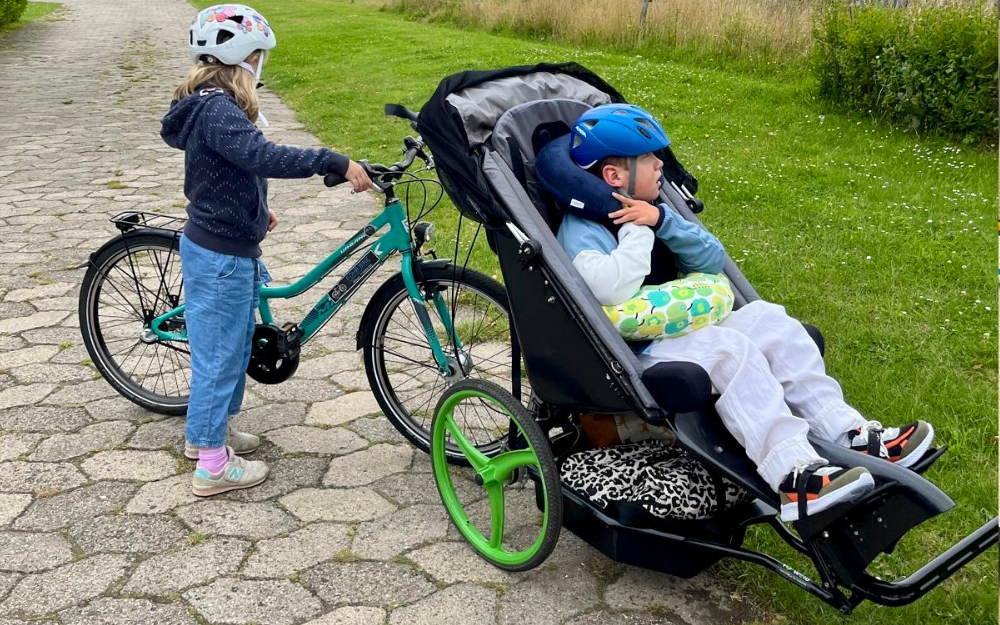
Cycling (tricycle, therapy bike, handbike, tandem)
Suitable for: Balance or strength deficits, hemiparesis, coordination disorders.
- Therapy tricycle with back/side guide, footrests, fixations
- Handbike (also as an attachment to the wheelchair)
- Tandem (also with pilot:in at the front), trailing clutch
- Adapted cranks, one-hand operation, motorized clutch (pedelec)
- Helmets, mirrors, flagpole for visibility
Wheelchair sports (basketball, rugby, dance, athletics)
- Sports wheelchair (fall-proof, camber wheels, protection systems)
- Handrims with grip, gloves, finger/hand orthoses
- Throwing baskets at variable heights, bumper balls with holding strap
- Launching devices, pull sledges, racing wheelchair
Horse riding / therapeutic riding
- Vaulting harness, saddle with handle, leg rests
- Climbing aid (ramp, lift), safety helmet, body protector
- Talker/AAC device on harness, pictogram cards
Climbing (toprope/bouldering)
- Full or upper body harnesses, additional chest harnesses
- Positioning seats, mechanical climbing aids (Jumar, pulley)
- Prosthesis/orthosis attachments with grip, hand loops
- Indoor routes with tactile markers or high contrast
Precision and low-impact sports (boccia, archery, table tennis)
- Boccia ramp, head/chin attachment, positioning chair
- Archery: Mouth tab, bow stand, one-hand release
- Table tennis: low tables, grip thickener, barrier-free border
Winter sports & kayaking
- Sit-ski/monoski, bi-ski, cross-country sledge
- Adaptive paddle, spraydeck with entry/exit aid
- Life jackets, cold management (heated gloves, heat pads)
Creative, musical and craft hobbies
music
- Grip thickening, support splints, Velcro fastenings
- Tactile/visual markings, colored notations
- Metronome with light/vibration, structure-borne sound transducers
- Eye-tracking or switch-based music software
- FM/radio systems, inductive listening systems
- Tablet holders, music stands with one-hand clamp
Art & DIY
- Scissors with spring opening, soft grips
- Brush holders, wrist rests, clipboards
- Potter's wheels with speed controller, fixing aids
- Height-adjustable tables, non-slip mats
Reading, writing, media design
- Magnification software, screen readers, Braille displays
- Dyslexia fonts, rulers/reading templates, voice output
- One-handed keyboards, eye control, head mouse, large buttons
- Spelling/speech assistance, dictation software
Gaming, robotics & coding
Gaming
- Adaptive controllers, modular buttons, foot pedals, joysticks
- Gooseneck arms, screen magnifier, high contrast
- One-handed gamepads, wheelchair mounts, switch scanning
Robotics & programming
- Block-based environments, screen reader compatible IDEs
- AAC integration, visual timers
- Haptic components, LEGO® Braille Bricks
Nature, animals & garden
- Raised beds, long lightweight tools, hand straps
- All-terrain wheelchairs/wheelchairs, rehab buggies
- Map apps with voice guidance, tactile compasses
- Sun protection, insect protection, allergy management
Aids: communication, sensor technology & protection
Augmentative and alternative communication (AAC)
- Symbol and letter talkers, robust covers, push-button access
- Mounting systems for wheelchairs, bicycles, horses, instruments
- Communication books, pictogram cards, social stories
Sensory support
- Noise-canceling, privacy screens, sun visors
- Weighted blankets/vests, fidgets
- Break plans, quiet zones, headphones with volume limitation
Positioning & protection
- Seat shells, side supports, headrests, orthoses
- Safety helmets, gloves, joint protectors
- Transfer aids, mobile lifts
Reduction of barriers
- Accessibility: stepless access, wide doors
- Time & structure: visual daily schedules, short sequences
- Competence: trainers with inclusion training
- Peer matching: buddy systems, mixed groups
- Safety: information on medication, emergency plan
Funding & care
- Medical prescription for medical aids, health insurance checks
- Care insurance fund provides support for everyday assistance
- Integration assistance/youth welfare for social participation
- Clubs/associations with loan equipment and trial offers
- Foundations & support associations for special equipment
- Pragmatic: test/loan first, then apply
Checklist
- Interest of the child (note 2-3 favorites)
- Clarify barriers & required functions
- Loan devices/trial organized
- Positioning & protection secured
- Communication (AAC/button/eye-tracking) available
- Association/group informed
- Funding/application prepared
- Plan B in case of overstimulation
Conclusion
The everyday lives of families with disabled children are often full of appointments. This makes the moments when children can simply be children - playing, discovering or being creative - all the more valuable. With the right aids, doors open to activities that previously seemed unattainable.
The right hobby not only brings joy and relaxation, but also self-confidence, friendships and the feeling of belonging.
Tips from the community:
Singfinger
We discovered Singfinger several years ago. With Singfinger, well-known songs are not only sung, but also accompanied with the hands to support spoken language. We started with the videos on YouTube and the songbooks. Now we are also part of the choir. We meet online every 2nd and 4th Tuesday of the month. The service is free, which makes it even better.
Almost the whole family is now involved and has learned to sign using spoken language in a fun way. We can already do a lot of signing, which we use in everyday life.
Riding
Our daughter has Angelman syndrome and was very wobbly on the horse at first. However, riding has given her much better posture - and it's great fun! She loves just getting on, riding and seeing the world from above.
We don't use any special aids. We usually put her directly on the horse and walk alongside to hold her by the leg if necessary. That used to be unthinkable: Back then, I had to support her by the leg as well as the back, otherwise she would have tipped backwards.
Swimming
She loves water - every little puddle has to be touched with her foot. When swimming, we use a life jacket and incontinence pants, as it is unfortunately very difficult to find suitable swim diapers in her size.