Safe in the car
Safety and comfort on all routes
What families really need to be relaxed on the road.
Depending on the type of disability and individual needs, there are various options that can make everyday life much easier. In this article, we take a look at common transportation options such as the wheelchair, the rehab car seat and special lifts, as well as the functions of modern rehab car seats.
Transporting a wheelchair in the car
There are special wheelchair transport systems that allow the wheelchair to be lifted into the trunk either manually or electrically. These systems provide valuable support, especially for families with higher mobility requirements. It is important that the wheelchair is securely fixed in the vehicle to prevent accidents and injuries in the event of a collision.
In many cases, the child can travel in the wheelchair. There are special brackets and safety belts that allow the wheelchair to be securely fastened so that the child remains stable and protected during the journey.
Rehab car seat
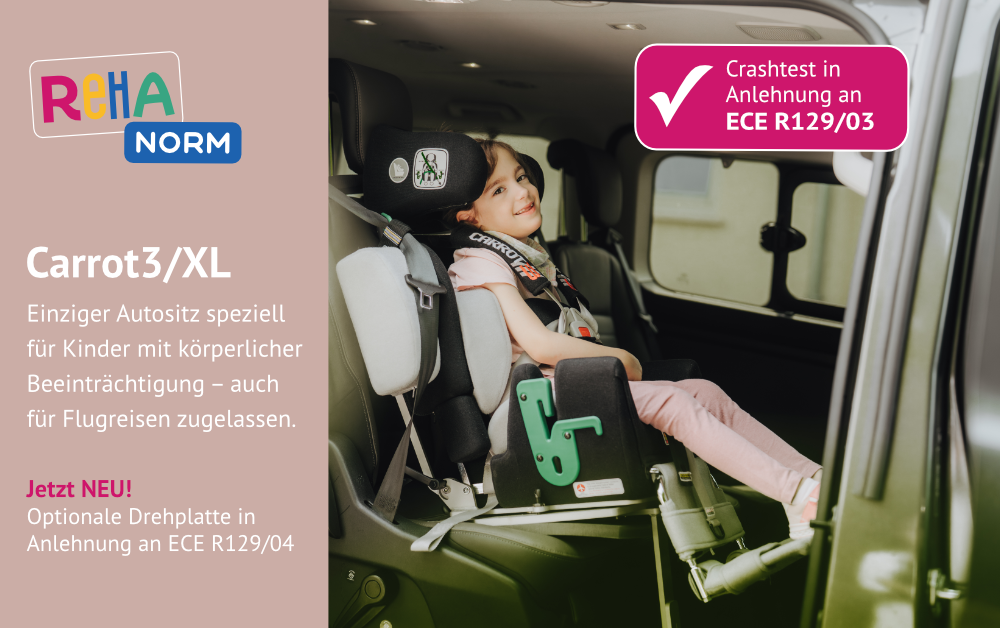
For children who cannot sit in a conventional child seat, there are rehab car seats that can be individually adapted to the child's needs. The most important functions of a rehab car seat include
- Adjustable backrest and seat angle: this feature allows the child's sitting position to be adjusted as required. For children who have difficulty sitting upright, the backrest can be tilted backwards.
- Pelvic and footrests: Adjustable footrests and a secure pelvic restraint are crucial to prevent the child from shifting during the journey. They help to ensure a healthy posture and stabilize the spine, especially for children who are unable to sit independently.
- Adjustable seat belts: The belt systems in rehab car seats can often be individually adjusted to optimally secure the child. Some models offer special shoulder straps for even more secure fixation, which prevent the child from slipping out of position during the journey.
- Padding and comfort: Well-padded, breathable seats prevent skin irritation and ensure a comfortable ride.
Lifts and lifting aids - Safe lifting into the car
Another common problem for parents of children with disabilities is lifting their child into the car. Lifts and lifting aids are indispensable, especially for children who cannot stand up or sit down independently. You can also read the article "Vehicle adaptations" here.
Conclusion
Being relaxed on the road starts with the right equipment. Individually adapted solutions such as wheelchair transport systems, rehab car seats and lifts not only ensure safety in the vehicle, but also make everyday life easier for the whole family.
When comfort, stability and ease of use work together, mobility becomes plannable and stress-free. This allows families to concentrate on the essentials: traveling together - safely, flexibly and with a good feeling.
Tips from the community:
Wheelchair and power knot
We have a Mercedes Citan with a built-in ramp. I can simply pushmy son in the backwith his wheelchair (HOGGI Cleo) and he is then strapped in with the power knot. We are very happy with it, it's a great relief.
First a rehab car seat, now a wheelchair in the car
We first had a rehab car seat from Anatomic Sitt, then a Carrot, but due to the spasticity and severe lordosis, sitting in these seats was not ideal. We therefore switched to the wheelchair for transportation, as transferring to the car seat became too difficult. The wheelchair has made the daily trips to therapy much easier. We have a wheelchair conversion in the VW Caddy and use the Tilty wheelchair from Sorg with a seat shell from Anatomic Sitt.
Rehab car seat with accessories
We also have a turntable under the rehab car seat, an abduction wedge and a footrest to improve comfort and stability while driving.
Lying in the reclining shell base
We transport my brother lying down in the Tina reclining shell base from Schuchmann.
At the moment, transportation in a car is only officially permitted as a special design with a valid medical certificate or belt release. The Tina has a five-point belt and a lap belt that is connected to the frame and fastening eyelets on the frame.
Traveling together in the car
What safety and comfort really mean for families.
Safety and comfort on all routes
What families really need to be relaxed on the road.
Depending on the type of disability and individual needs, there are various options that can make everyday life much easier. In this article, we take a look at common transportation options such as the wheelchair, the rehab car seat and special lifts, as well as the functions of modern rehab car seats.
Transporting a wheelchair in the car
There are special wheelchair transport systems that allow the wheelchair to be lifted into the trunk either manually or electrically. These systems provide valuable support, especially for families with higher mobility requirements. It is important that the wheelchair is securely fixed in the vehicle to prevent accidents and injuries in the event of a collision.
In many cases, the child can travel in the wheelchair. There are special brackets and safety belts that allow the wheelchair to be securely fastened so that the child remains stable and protected during the journey.
Rehab car seat
For children who cannot sit in a conventional child seat, there are rehab car seats that can be individually adapted to the child's needs. The most important functions of a rehab car seat include
- Adjustable backrest and seat angle: this feature allows the child's sitting position to be adjusted as required. For children who have difficulty sitting upright, the backrest can be tilted backwards.
- Pelvic and footrests: Adjustable footrests and a secure pelvic restraint are crucial to prevent the child from shifting during the journey. They help to ensure a healthy posture and stabilize the spine, especially for children who are unable to sit independently.
- Adjustable seat belts: The belt systems in rehab car seats can often be individually adjusted to optimally secure the child. Some models offer special shoulder straps for even more secure fixation, which prevent the child from slipping out of position during the journey.
- Padding and comfort: Well-padded, breathable seats prevent skin irritation and ensure a comfortable ride.
Lifts and lifting aids - Safe lifting into the car
Another common problem for parents of children with disabilities is lifting their child into the car. Lifts and lifting aids are indispensable, especially for children who cannot stand up or sit down independently. You can also read the article "Vehicle adaptations" here.
Conclusion
Being relaxed on the road starts with the right equipment. Individually adapted solutions such as wheelchair transport systems, rehab car seats and lifts not only ensure safety in the vehicle, but also make everyday life easier for the whole family.
When comfort, stability and ease of use work together, mobility becomes plannable and stress-free. This allows families to concentrate on the essentials: traveling together - safely, flexibly and with a good feeling.
Tips from the community:
Wheelchair and power knot
We have a Mercedes Citan with a built-in ramp. I can simply pushmy son in the backwith his wheelchair (HOGGI Cleo) and he is then strapped in with the power knot. We are very happy with it, it's a great relief.
First a rehab car seat, now a wheelchair in the car
We first had a rehab car seat from Anatomic Sitt, then a Carrot, but due to the spasticity and severe lordosis, sitting in these seats was not ideal. We therefore switched to the wheelchair for transportation, as transferring to the car seat became too difficult. The wheelchair has made the daily trips to therapy much easier. We have a wheelchair conversion in the VW Caddy and use the Tilty wheelchair from Sorg with a seat shell from Anatomic Sitt.
Rehab car seat with accessories
We also have a turntable under the rehab car seat, an abduction wedge and a footrest to improve comfort and stability while driving.
Lying in the reclining shell base
We transport my brother lying down in the Tina reclining shell base from Schuchmann.
Currently, transportation in a car is only officially permitted as a special design with a valid medical certificate or seatbelt exemption. The Tina has a five-point belt and a lap belt that is connected to the frame and fastening eyelets on the frame.