Positioning in everyday life
Safety and relief through good positioning
How children lie securely and sit stably - and what this changes in everyday life.
Correct positioning is crucial for children who cannot move independently or can only move to a limited extent. It prevents pressure points, poor posture and pain, facilitates breathing and can even improve digestion and well-being. It also ensures that your child can actively participate in family life - instead of lying on the sidelines or always remaining in the same position.
The aim is to provide as much support as necessary and as much freedom of movement as possible.
Where can I position my child?
Depending on the occasion and time of day, different places and aids are suitable for positioning. Here is an overview of common options:
- In the childcare bed: The bed is usually the central place for the night, but is also important during the day. Height adjustment makes care easier, side rails provide safety and a pressure-relieving mattress prevents pressure sores.
- On the sofa or a lounger: Practical for everyday life if you want your child to be in the middle of family activities. Make sure there is enough space for positioning aids and a non-slip surface.
- On the play mat or therapy table on the floor: The floor is often the freest place - here your child can spread out, move their arms and legs and play safely at the same time.
Aids that make everyday life easier
To ensure that positioning does not become a challenge, there are a number of aids that have proven their worth in everyday life:
- Wedge cushions and inclined positioning wedges - they help with a slight inclined position and relieve pressure on certain parts of the body.
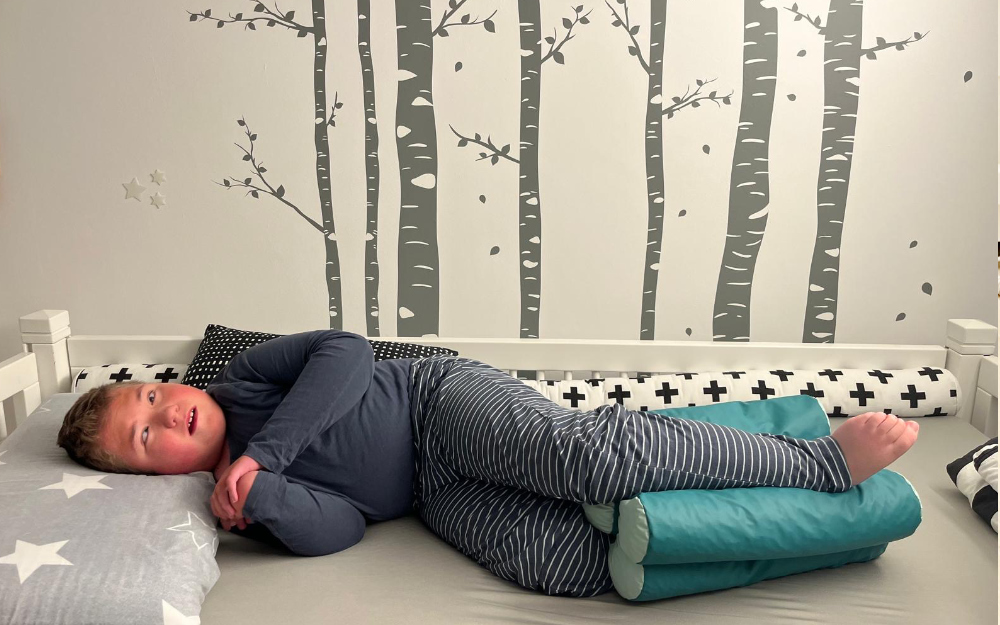
- Positioning rolls or half rolls - support arms and legs, stabilize the lateral position or simply provide some distance.
- H-shaped pillows or nest pillows - gently frame the body and prevent your child from sliding to the side.
- Modular positioning systems - consist of different cushions and castors that can be flexibly combined depending on the situation and requirements.
- Repositioning and turning aids - special sheets or pads make it easier to move your child safely and gently into a different position.
- Special mattresses - distribute the pressure more evenly; they are a good addition, but do not replace regular changes of position.
- Sitting and positioning chairs - provide stability when seated, allowing active participation when playing or eating.
- Standing devices - offer children who cannot stand independently the opportunity to stand upright; this strengthens bones, muscles and participation.
All of these aids should be individually adapted, ideally in close consultation with therapists or rehabilitation technicians.
What should I look out for?
- Customize individually: No support is "off the shelf". Every child reacts differently, especially with muscle tension or spasticity.
- Stable, but not fixed: Aids should provide support but not completely prevent movement.
- Hygiene and material: Removable, washable covers are worth their weight in gold. Also look out for breathable and comfortable materials.
- Don't forget to change position: Even with a special mattress, lying in one position should not take too long.
- Listen to your child: If it becomes restless, breathing becomes more difficult or the face shows signs of discomfort, the position may not be suitable.
- Rethink regularly: Children grow, muscles change - and so do the requirements for positioning.
How long should I stay in one position?
There is no fixed time rule because every child is different. As a guide: children who do not move much should be repositioned after two hours at the latest, and often after a shorter time if they are seated. If the pressure is well relieved and the child is comfortable, a position can be held for longer - as long as you keep an eye on your child's skin, breathing and mood.
A day of positioning in practice (example)
This is what a daily routine could look like - please always pay attention to your child's individual needs:
- In the morning: Start in the supine position in the nursing bed, with small pillows under the legs. Then switch to a gentle side position.
- In the morning: Sitting phase in the positioning chair at the breakfast table.
- Midday: Time on the play mat to move and play more freely.
- Afternoon: Quiet lying phase on the sofa with roll support and reading aloud to relax.
- Evening: Back in the care bed - slightly inclined position to fall asleep, change position to side lying at night.
Conclusion
Correct positioning does not mean "immobilizing" the child, but giving them stability, protection and freedom of movement at the same time. It's about striking a balance between support and freedom - adapted to your child's individual needs. With the right aids and in close cooperation with specialists, you can find a position that makes everyday life easier and strengthens your child.
How can I support my child with a disability in a lying and sitting position?
Why positioning is so important
Correct positioning is crucial for children who cannot move independently or only to a limited extent. It prevents pressure sores, poor posture and pain, facilitates breathing and can even improve digestion and well-being. It also ensures that your child can actively participate in family life - instead of lying on the sidelines or always remaining in the same position.
The aim is to provide as much support as necessary and as much freedom of movement as possible.
Where can I position my child?
Depending on the occasion and time of day, different places and aids are suitable for positioning. Here is an overview of common options:
- In the childcare bed: The bed is usually the central place for the night, but is also important during the day. Height adjustment makes care easier, side rails provide safety and a pressure-relieving mattress prevents pressure sores.
- On the sofa or a lounger: Practical for everyday life if you want your child to be in the middle of family activities. Make sure there is enough space for positioning aids and a non-slip surface.
- On the play mat or therapy table on the floor: The floor is often the freest place - here your child can spread out, move their arms and legs and play safely at the same time.
Aids that make everyday life easier
To ensure that positioning does not become a challenge, there are a number of aids that have proven their worth in everyday life:
- Wedge cushions and inclined positioning wedges - they help with a slight inclined position and relieve pressure on certain parts of the body.
- Positioning rolls or half rolls - support arms and legs, stabilize the lateral position or simply provide some distance.
- H-shaped pillows or nest pillows - gently frame the body and prevent your child from sliding to the side.
- Modular positioning systems - consist of different cushions and castors that can be flexibly combined depending on the situation and requirements.
- Repositioning and turning aids - special sheets or pads make it easier to move your child safely and gently into a different position.
- Special mattresses - distribute the pressure more evenly; they are a good addition, but do not replace regular changes of position.
- Sitting and positioning chairs - provide stability when seated, allowing active participation when playing or eating.
- Standing devices - offer children who cannot stand independently the opportunity to stand upright; this strengthens bones, muscles and participation.
All of these aids should be individually adapted, preferably in close consultation with a therapist or rehabilitation technician.
What should I look out for?
- Customize individually: No support is "off the shelf". Every child reacts differently, especially with muscle tension or spasticity.
- Stable, but not fixed: Aids should provide support but not completely prevent movement.
- Hygiene and material: Removable, washable covers are worth their weight in gold. Also look out for breathable and comfortable materials.
- Don't forget to change position: Even with a special mattress, lying in one position should not take too long.
- Listen to your child: If it becomes restless, breathing becomes more difficult or the face shows signs of discomfort, the position may not be suitable.
- Rethink regularly: Children grow, muscles change - and so do the requirements for positioning.
How long should you stay in one position?
There is no fixed time rule because every child is different. As a guide: children who do not move much should be repositioned after two hours at the latest, and often after a shorter time if they are seated. If the pressure is well relieved and the child is comfortable, a position can be held for longer - as long as you keep an eye on your child's skin, breathing and mood.
A day of positioning in practice (example)
This is what a daily routine could look like - please always pay attention to your child's individual needs:
- In the morning: Start in the supine position in the nursing bed, with small pillows under the legs. Then switch to a gentle side position.
- In the morning: Sitting phase in the positioning chair at the breakfast table.
- Midday: Time on the play mat to move and play more freely.
- Afternoon: Quiet lying phase on the sofa with roll support and reading aloud to relax.
- Evening: Back in the care bed - slightly inclined position to fall asleep, change position to side lying at night.
Conclusion
Correct positioning does not mean "immobilizing" the child, but giving them stability, protection and freedom of movement at the same time. It's about striking a balance between support and freedom - adapted to your child's individual needs. With the right aids and in close cooperation with specialists, you can find a position that makes everyday life easier and strengthens your child.