Temporary aids
Support for certain phases of life
When aids are only needed temporarily - and still make a big difference.
Your child is dependent on one or more assistive devices to cope with everyday life and you are equipped accordingly, for example with a rehab buggy, a therapy chair or a childcare bed. But what do you do if your child's needs change at short notice, for example during rehabilitation after an operation, and you need new aids to meet these changed needs? Or - and this is the much nicer option - you go on vacation and can't take all the aids you need with you for logistical reasons. The need therefore remains the same, but a change of location makes it necessary to provide aids at short notice and for a limited period of time. How can you react flexibly to the changed but temporary need? We explain this in this article.
1 Temporarily required aids: what are they?
Temporarily required aids are devices and aids that are only used for a limited period of time, for example (selection):
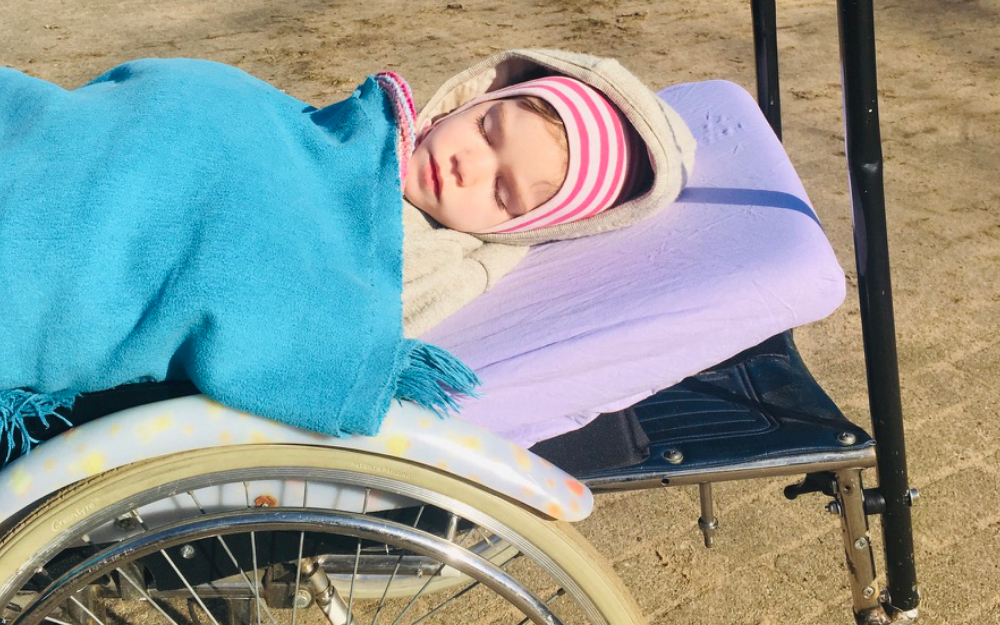
- Reclining wheelchairs following hip or pelvic surgery: These support the child during the healing phase to ensure mobility and promote recovery.
- Second childcare bed on the first floor: An additional bed on the first floor can make everyday life much easier for the period after an operation or in the event of acute restrictions. For example, to save a transfer to a children's room further up.
- Mobile lift: For support during transfers during the rehabilitation phase or in the event of temporary mobility restrictions.
- Positioning orthoses: After an operation, for example, to ensure the long-term outcome of the operation
- Special children's bicycles or bicycle trailers: For vacations when the child is dependent on an adapted bicycle, but transportation from home is simply not possible.
- Rehab buggy: If the child would like to actively participate in the activities on vacation (e.g. on the beach), but it is not possible to take it along in the car for space reasons, for example because the wheelchair is used as a transport option in the car, but it is not suitable for outdoor use.
- Shower/toilet chair: To be able to provide the child with the best possible care during the vacation. However, depending on the size of the aid and the type of trip (e.g. air travel), it may not be possible to take it with you for logistical reasons.
2 Why temporary aids are useful
The use of temporary aids can speed up the healing process, relieve pain, ensure mobility and make everyday life easier for the family. They are often necessary to maintain the child's independence during recovery or to make vacations barrier-free.
3. who lends temporary aids?
There are various organizations and providers that lend temporary aids:
- Medical supply stores and specialist retailers: some offer rental services for special equipment such as lifts, wheelchairs or care beds. In the run-up to an operation, for example, special positioning orthoses are made which can then be used post-operatively. The treating clinics often work together with medical supply stores.
- Health insurance companies: In some cases, health insurance companies will cover the cost of renting or purchasing temporary aids, especially if they are medically necessary.
- Associations and non-profit organizations: Some organizations lend assistive devices free of charge or for a small fee, e.g. for vacations.
4 Financing and assumption of costs
The cost of temporary aids can vary. Here are some important points:
- Health insurance: If medically necessary, health insurance usually covers the cost of rental or purchase. A doctor's prescription is required for this.
- Social welfare / integration assistance: If the need is long-term, the social welfare office can cover the costs. In this case, an application proving the necessity is required.
- Personal contribution: Some rental offers or aids may incur a personal contribution. It is worth clarifying in advance exactly what costs will be incurred by the family.
- Funding opportunities: In addition, there are funding programs, e.g. through Aktion Mensch or special funding from health insurance companies, which can support the purchase or rental of temporary aids.
5 Tips for parents: How to find the right aid
- Consult with medical specialists and therapists: They can assess the necessity and duration of use and help with the selection.
- Contact health insurance companies and social services: Clarify at an early stage which costs are covered and which applications are necessary.
- Research rental organizations: Find out about local providers, associations or online platforms that lend temporary aids.
- Advice from specialist retailers: They can offer individual solutions and provide support with handling.
6. aids for vacations: temporary support on the move
Vacations are a special time when the child often needs special aids to make the trip comfortable and barrier-free. Here are a few examples:
Disabled children's bikes and bike trailers: for outdoor vacations to be active together and ensure mobility.
Mobile lifts: For transfers in the hotel or vacation home to ensure mobility and make everyday life easier.
Other travel aids: Special beds, ramps or mobile shower/toilet chairs to make your vacation easier.
Many rental companies and organizations offer special vacation kits that can be rented for the duration of the vacation. It is worth planning well in advance and researching suitable offers.
Conclusion
Temporary aids are a valuable support for families with children who are only temporarily dependent on special equipment. They facilitate recovery, improve quality of life and enable barrier-free leisure activities. It is important to contact the right people at an early stage, clarify who will cover the costs and make use of suitable rental options.
Tips from the community:
Recumbent wheelchair
After Finja was no longer able to sit after her hip operation, we urgently needed a recumbent wheelchair. Fortunately, we were able to borrow one from a medical supply store.
It was also important to us that she could lie safely and comfortably in her positioning rail in our living room. We got a second care bed for this.
Multifunctional aids
Our car (T7) always seems too small when the five of us go on vacation with Rollikind. When purchasing new aids, we make sure that they are as multifunctional as possible - for example, a commode chair that is also suitable for showering, or a buggy that is suitable for both the beach and the mountains.
We order consumables and care aids such as diapers, catheters or disinfectants in advance from a pharmacy at the vacation destination. This saves space.
We rent a beach wheelchair conveniently on site.
We have also thought about renting a care bed or shower chair locally, for example from a medical supply store. However, this has not yet been necessary.
Positioning system
We had a hip operation in 2022. Emma had to spend six weeks in a positioning system and we needed a rehab trolley that she could fit into and another care bed for the time being. RAS was a great help.
Positioning wedge
We used a positioning wedge to spread her hips apart temporarily to prevent or compensate for the misalignment of her hips due to the strong internal rotation. However, our experience with it was not particularly good - it is not suitable for everyday use and it was also rather difficult at night. We now use a better aid during the day, namely a Dero-Twist hip orthosis, which we get on with much better. After my orthoses, it is the most important aid for me. The hip orthosis is put on in the morning and taken off again in the evening. We are very happy with it and get on well.
Temporary care bed
A care bed after the hip operation until my own care bed could be delivered: In itself, this was not a problem. As it was necessary, we had the bed delivered to our home and assembled while we were still in hospital. When we no longer needed it, they picked it up after consultation.
Rehab buggy
We had a rehab buggy until my daughter could reliably walk on her own. It was all very straightforward and a real relief. Without our orthopaedist, who prescribed the rehab buggy for us at the time, we would never have known that there was such an option. It was a real game changer. We would have urgently needed this information much earlier.
Surveillance monitor
We used to have the Vitaguard from Getemed for monitoring vital functions, but we gave it back after two or three years because it was no longer necessary to monitor our daughter.