Therapy chairs
Sitting with support in everyday life
Between participation, support and a permanent place in family life.
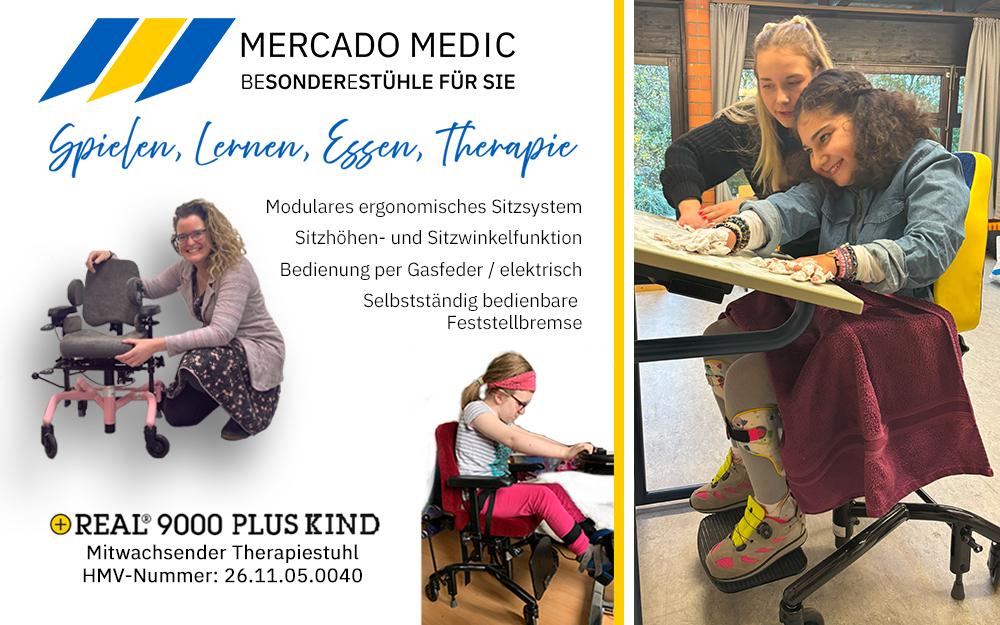
Therapy chairs for children are specialized aids that are used in therapy, rehabilitation and for the daily support of children with motor or neurological impairments. They offer a safe, comfortable and adjustable sitting position that is specially adapted to the needs of children. These chairs are particularly valuable for children who have difficulty moving or maintaining a healthy posture due to developmental disorders, neurological conditions or physical limitations.
From what age is a therapy chair useful?
Therapy chairs can be beneficial from a very young age. They are often suitable for children aged from around 6 months to adolescence, although the exact age may vary depending on the child's individual development and specific needs. A therapy chair is a particularly valuable support for children with motor or neurological impairments, such as cerebral palsy children or those with muscle weaknesses.
In the first few years of life, when children are still learning to control and coordinate their muscles, a therapy chair can help to stabilize posture and promote muscle strength. In later years, the chair can help to increase mobility and independence and ensure an ergonomic sitting position during work or leisure time.
Advantages of a therapy chair
- Promotes mobility and independence
- Improvement of posture and prevention of poor posture
- Adaptability
- Promotion of motor development
Therapy chair vs. wheelchair
- Flexibility:
- Therapy chair: Can be flexibly adapted, e.g. adjusted down to floor level to allow the child to adopt different positions and perform therapeutic exercises. Very versatile in use.
- Wheelchair: Designed more for locomotion, less flexible in terms of seat adjustment, takes up a lot of space, especially indoors. Must be cleaned after outdoor use.
- Positioning:
- Therapy chair: Provides a stable sitting position and can be used in various therapeutic situations. Particularly useful, for example, when playing with other children on the floor to encourage interaction and promote healthy posture.
- Wheelchair: Enables locomotion but is not intended for therapeutic exercises or postural correction.
- Adaptability:
- Therapy chair: Can be adapted to the child's individual needs (e.g. adjustable backrest, footrests, seat height) to provide optimal support and comfort.
- Wheelchair: Focused on locomotion, adaptations are mostly geared towards driving and sitting. Less customization options in terms of therapeutic support.
- Combination of both:
A therapy chair can ideally complement the wheelchair to support targeted therapeutic exercises, while the wheelchair provides locomotion in everyday life. Both aids together provide comprehensive support for the child's mobility and therapeutic needs.
Base with seat or adapted seat shell?
Therapy chairs for children can either be equipped with a base and seat or with an adapted seat shell, depending on the child's specific needs.
- Base with seat: An adjustable base with a simple but stable seat offers flexibility and can be used in different environments. This variant is particularly practical if the therapy chair is to be used in several situations, for example at home as well as at school or in therapy.
- Adapted seat shell: An adapted seat shell is ideal for children who require additional support. This provides a tighter, more stable fit, which improves the child's posture and at the same time offers maximum safety. This option is particularly preferred for more severe motor impairments, as it provides better support for the body.
to the seat shells
Therapy chair in daycare, school and at home
Therapy chairs are not only useful at home, but are also a valuable aid in daycare centers and schools. In educational institutions, the therapy chair enables children to adopt a healthy sitting posture and actively participate in lessons. Therapy chairs can be easily integrated into different environments thanks to their customizable features.
Another advantage is that therapy chairs can also be used in different environments, which makes it easier to integrate the child into everyday life. Many children can use the therapy chair both at home and at nursery or school, which supports the continuity of therapy and the improvement of mobility.
Dual care
Dual use is an important consideration when it comes to the provision of therapy chairs. In many cases, children need a therapy chair both at home and at school or in the therapy center. The dual provision of a therapy chair for these different environments ensures that the child continually receives the support they need to make progress in their mobility and posture.
It is important that parents and caregivers work together with the therapists and professionals to decide how and where the therapy chair should be used to ensure optimal support and care.
Conclusion
A therapy chair is much more than just a seat - it creates stability, promotes development and enables real participation in everyday life. Whether playing, learning or spending time together as a family: The right seating solution helps children to be active and develop their abilities to the best of their ability. In combination with other aids, it becomes an important building block for greater independence, comfort and quality of life.
Tips from the community:
Stability, seating comfort, colors
It was important to us that the chair was stable and that the child could sit in it comfortably. It was also important to us that the chair was available in attractive colors.
Floor-level setting for playing
It was important to us that the chair could be lowered to floor level so that our child could easily play with other children at the same height.
Height adjustment for versatile use
The height adjustment was an important point for us so that the chair can be used both at the dining table and on the kitchen worktop.
Simple tilt function
The ability to easily tilt the chair was also important to us in order to adapt the chair flexibly to different situations and needs.
Colors, seating comfort, wheels
A beautiful design with colors that you can choose yourself was particularly important to us - and even without additional payment. The good stability of the chair was also important to us, so that the seat doesn't tip over even when our child is rocking. The chair offers very good seating comfort and ensures that the wheels don't get stuck on the smallest of thresholds.
Steerable and brakeable wheels
All four wheels can be steered and braked, which is particularly practical if the child is using a Motomed, for example. It is really impractical if the child is pedaling but the front wheels cannot be braked or locked. In addition, the wheels are big enough not to get stuck on every elevator threshold - an important standard that we really appreciate.
Operation, grow-along function
For me personally, user-friendliness is very important. The chair must be easy to operate and at the same time offer the child a high level of seating comfort. Large, heavy chairs that are difficult to adjust are not ideal for everyday use. It would also be great if the chair could grow with the child, with interchangeable parts available in different sizes.
Wheelchair with customized seat shell instead of therapy chair
We currently use a wheelchair exclusively, both at home and at school. It is perfectly adjusted to the height of our dining table, and there are height-adjustable tables at school. The seat shell in the wheelchair is individually adjusted and offers maximum seating comfort and a balanced level of stability, so we don't currently see any additional benefit in a therapy chair. But this can certainly change depending on age and spatial conditions.
At eye level
We have the Special Tomato seat and use a trolley as a base. This means that our son is always at eye level with his daycare friends and can also be pushed comfortably by the teachers and his friends.
Therapy chairs in everyday family life
Between support, participation and a place in the middle of life
Sitting with support in everyday life
Between participation, support and a permanent place in family life.
Therapy chairs for children are specialized aids that are used in therapy, rehabilitation and for the daily support of children with motor or neurological impairments. They offer a safe, comfortable and adjustable sitting position that is specially adapted to the needs of children. These chairs are particularly valuable for children who have difficulty moving or maintaining a healthy posture due to developmental disorders, neurological conditions or physical limitations.
From what age is a therapy chair useful?
Therapy chairs can be beneficial from a very young age. They are often suitable for children aged from around 6 months to adolescence, although the exact age may vary depending on the child's individual development and specific needs. A therapy chair is a particularly valuable support for children with motor or neurological impairments, such as cerebral palsy children or those with muscle weaknesses.
In the first few years of life, when children are still learning to control and coordinate their muscles, a therapy chair can help to stabilize posture and promote muscle strength. In later years, the chair can help to increase mobility and independence and ensure an ergonomic sitting position during work or leisure time.
Advantages of a therapy chair
- Promotes mobility and independence
- Improvement of posture and prevention of poor posture
- Adaptability
- Promotion of motor development
Therapy chair vs. wheelchair
- Flexibility:
- Therapy chair: Can be flexibly adapted, e.g. adjusted down to floor level to allow the child to adopt different positions and perform therapeutic exercises. Very versatile in use.
- Wheelchair: Designed more for locomotion, less flexible in terms of seat adjustment, takes up a lot of space, especially indoors. Must be cleaned after outdoor use.
- Positioning:
- Therapy chair: Provides a stable sitting position and can be used in various therapeutic situations. Particularly useful, for example, when playing with other children on the floor to encourage interaction and promote healthy posture.
- Wheelchair: Enables locomotion but is not intended for therapeutic exercises or postural correction.
- Adaptability:
- Therapy chair: Can be adapted to the child's individual needs (e.g. adjustable backrest, footrests, seat height) to provide optimal support and comfort.
- Wheelchair: Focused on locomotion, adaptations are mostly geared towards driving and sitting. Less customization options in terms of therapeutic support.
- Combination of both:
A therapy chair can ideally complement the wheelchair to support targeted therapeutic exercises, while the wheelchair provides locomotion in everyday life. Both aids together provide comprehensive support for the child's mobility and therapeutic needs.
Base with seat or adapted seat shell?
Therapy chairs for children can either be equipped with a base and seat or with an adapted seat shell, depending on the child's specific needs.
- Base with seat: An adjustable base with a simple but stable seat offers flexibility and can be used in different environments. This variant is particularly practical if the therapy chair is to be used in several situations, for example at home as well as at school or in therapy.
- Adapted seat shell: An adapted seat shell is ideal for children who require additional support. This provides a tighter, more stable fit, which improves the child's posture and at the same time offers maximum safety. This option is particularly preferred for more severe motor impairments, as it provides better support for the body.
to the seat shells
Therapy chair in daycare, school and at home
Therapy chairs are not only useful at home, but are also a valuable aid in daycare centers and schools. In educational institutions, the therapy chair enables children to adopt a healthy sitting posture and actively participate in lessons. Therapy chairs can be easily integrated into different environments thanks to their customizable features.
Another advantage is that therapy chairs can also be used in different environments, which makes it easier to integrate the child into everyday life. Many children can use the therapy chair both at home and at nursery or school, which supports the continuity of therapy and the improvement of mobility.
Dual care
Dual use is an important consideration when it comes to the provision of therapy chairs. In many cases, children need a therapy chair both at home and at school or in the therapy center. The dual provision of a therapy chair for these different environments ensures that the child continually receives the support they need to make progress in their mobility and posture.
It is important that parents and caregivers work with the therapists and professionals to decide how and where the therapy chair should be used to ensure optimal support and care.
Conclusion
A therapy chair is much more than just a seat - it creates stability, promotes development and enables real participation in everyday life. Whether playing, learning or spending time together as a family: The right seating solution helps children to be active and develop their abilities to the best of their ability. In combination with other aids, it becomes an important building block for greater independence, comfort and quality of life.
Tips from the community:
Stability, seating comfort, colors
It was important to us that the chair was stable and that the child could sit in it comfortably. It was also important to us that the chair was available in attractive colors.
Floor-level setting for playing
It was important to us that the chair could be lowered to floor level so that our child could easily play with other children at the same height.
Height adjustment for versatile use
The height adjustment was an important point for us so that the chair can be used both at the dining table and on the kitchen worktop.
Simple tilt function
The ability to easily tilt the chair was also important to us in order to adapt the chair flexibly to different situations and needs.
Colors, seating comfort, wheels
A beautiful design with colors that you can choose yourself was particularly important to us - and even without additional payment. The good stability of the chair was also important to us, so that the seat doesn't tip over even when our child is rocking. The chair offers very good seating comfort and ensures that the wheels don't get stuck on the smallest of thresholds.
Steerable and brakeable wheels
All four wheels can be steered and braked, which is particularly practical if the child is using a Motomed, for example. It is really impractical if the child is pedaling but the front wheels cannot be braked or locked. In addition, the wheels are big enough not to get stuck on every elevator threshold - an important standard that we really appreciate.
Operation, grow-along function
For me personally, user-friendliness is very important. The chair must be easy to use and at the same time offer the child a high level of comfort. Large, heavy chairs that are difficult to adjust are not ideal for everyday use. It would also be great if the chair could grow with the child, with interchangeable parts available in different sizes.
Wheelchair with customized seat shell instead of therapy chair
We currently use a wheelchair exclusively, both at home and at school. It is perfectly adjusted to the height of our dining table, and there are height-adjustable tables at school. The seat shell in the wheelchair is individually adjusted and offers maximum seating comfort and a balanced level of stability, so we don't currently see any additional benefit in a therapy chair. But this can certainly change depending on age and spatial conditions.
At eye level
We have the Special Tomato seat and use a trolley as a base. This means that our son is always at eye level with his daycare friends and can also be pushed comfortably by the teachers and his friends.