Weighted Blankets and Animals
Weighted Blankets, Weighted Vests, and Weighted Stuffed Animals: How Deep Pressure Can
Help Children
A weighted blanket, a weighted stuffed animal, or a weighted vest—and suddenly the world feels a little calmer. Weighted blankets, vests, and stuffed animals are increasingly being used as tools for body awareness, especially for children and adolescents with specific sensory needs, such as ADHD and autism, or simply those who experience restlessness. But what’s actually behind this trend?
How does a weighted blanket or stuffed animal work?
While it’s difficult to prove
scientifically, the principle is actually quite simple: a weighted blanket or stuffed animal exerts even pressure on the body through its added weight.
Many people find this deep, even pressure pleasant and soothing. It can feel a bit like someone is giving you a gentle, steady hug.
And that’s exactly why weighted products are helpful for some children who have trouble calming down, processing sensory input, or being aware of their bodies.
In short: Sometimes it just feels like you need a little more pressure.
Why can weight have a calming effect?
Our bodies are constantly processing information: touch, movement, sounds, light, our body’s position, and much more.
Which weighted blanket, vest, or stuffed animal is the right one?
A weighted blanket for children should always be selected on an individual basis. Key factors include the child’s weight, height, mobility, and ability to remove the blanket on their own.
How heavy should a weighted blanket or toy be for children?
A weighted blanket should not simply be chosen based on a blanket percentage rule. For children, factors such as age, height, mobility, sensory needs, and the ability to remove the blanket on their own play a role in addition to body weight. For children with physical or neurological limitations, the selection should be coordinated with specialists.
Are weighted blankets safe for children?
Weighted
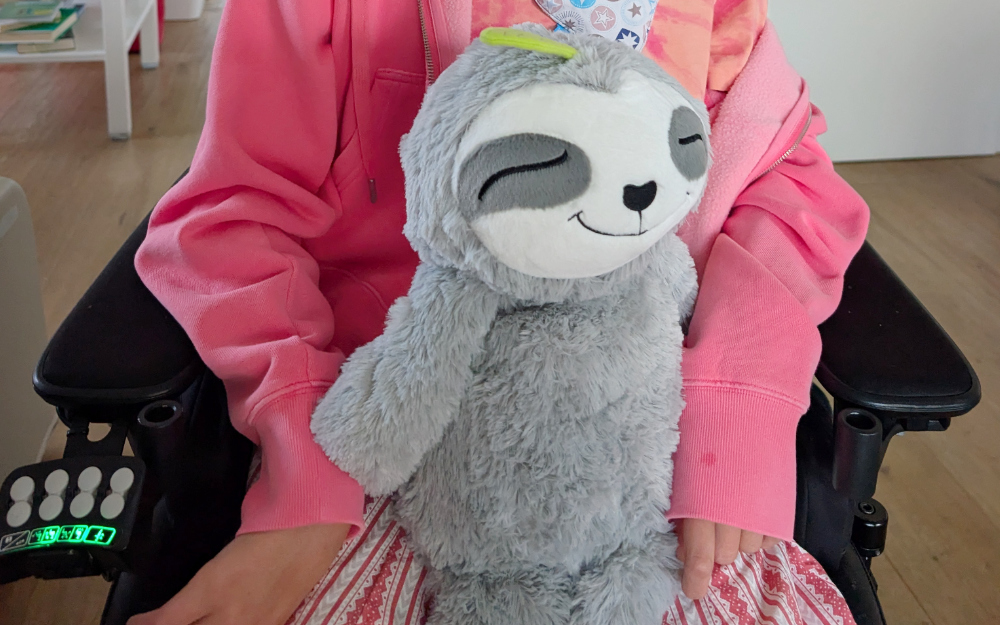
blankets and weighted stuffed animals can be comforting for many children. However, special attention is required when using them, particularly for children with disabilities or specific sensory needs. A weighted blanket should always be tailored to the individual child and their abilities.
Above all, it is important that:
The child should be able to push the blanket away or free themselves from it on their own. A weighted blanket must never be used to restrain a child or restrict their movements.
The head and face must always remain uncovered. The blanket must not interfere with breathing or be pulled over the head.
The weight should be appropriate. More weight does not automatically mean greater effectiveness. Body size, weight, mobility, age, and individual sensory needs should be taken into account.
Special caution is required in cases of limited mobility. Children who cannot change their position on their own or remove the blanket independently should not use a weighted blanket unsupervised.
Certain health conditions may also be relevant. In cases of respiratory, cardiovascular, or neuromuscular conditions, as well as other physical limitations, use should be discussed in advance with a doctor or another qualified professional.
The child should have a say in the matter. If the child pushes the blanket away, becomes restless, feels uncomfortable, or clearly does not want it, the blanket should no longer be used.
It is particularly important to note that a weighted blanket is not a restraint or sedative intended to immobilize a child against their will. It can be a sensory aid that helps a child feel more comfortable and secure—but only if it actually feels pleasant to that particular child.
Weighted blankets and weighted animals
Further reading & sources:
1. In a randomized study, Gringras et al. examined 67 children with autism and significant sleep problems. The results are interesting: The weighted blanket did not significantly improve objectively measured sleep duration or time to fall asleep. At the same time, both children and parents preferred the weighted blanket, and it was well tolerated.
PubMed: Weighted blankets and sleep in autistic children – a randomized controlled trial
2. Recent study on children with ADHD
A randomized crossover study involving 94 children with ADHD and sleep problems yielded somewhat more positive results in 2024: Weighted blankets improved total sleep time, sleep efficiency, and wake time after falling asleep—though the effects were relatively small.
PubMed: The efficacy of weighted blankets for sleep in children with ADHD
3. What do children and families report?
A retrospective study involving 85 people with ADHD and/or autism—including 48 children—reported positive experiences regarding falling asleep, staying asleep, and relaxation. However, this was not a randomized controlled trial, so the results must be interpreted differently.
PubMed: Effectiveness of weighted blankets on sleep and everyday activities