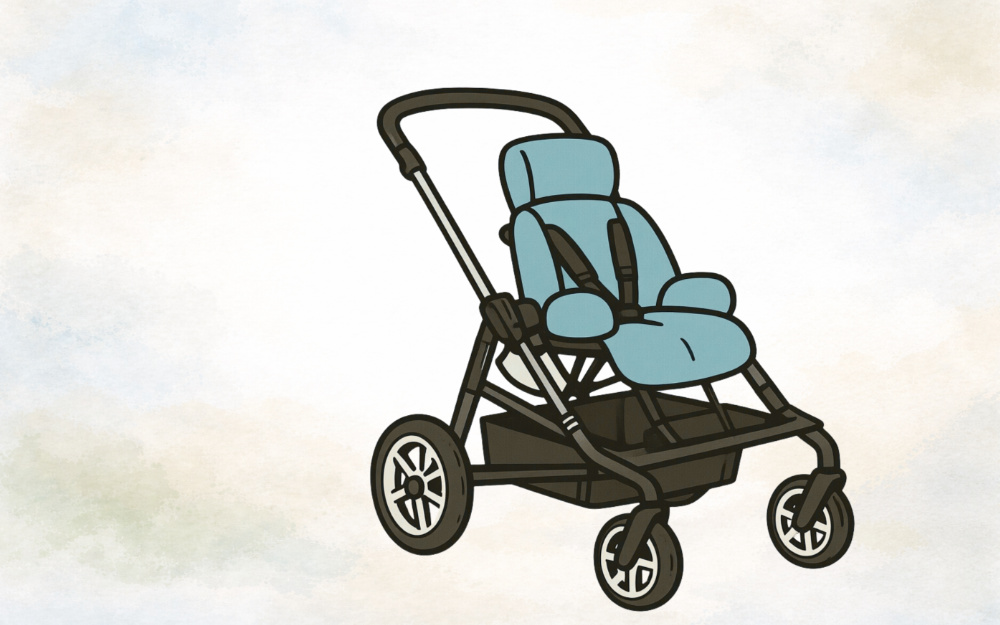
Rehab buggy
Mobility that grows with the child
How a suitable buggy supports everyday life and development
A rehab buggy must not only be functional and safe, but also meet the specific needs of your child. There are a number of aspects that should be taken into account when making your choice. From expert advice to the individual adaptability of the buggy - in this article, we present the key factors that play a role in choosing the perfect rehab buggy.
- Obtain specialist advice
Consult a therapist, a medical supply store or an SPC to find the best options for your child together. - Your child's physical needs
Pay attention to stability, adjustable footrests and safety belts to prevent incorrect posture and ensure safety. - Adaptability of the buggy
An ideal rehab buggy must be adaptable to your child's needs, as these can change over time. Make sure that the buggy:- Adjustable seat and backrest positions
- Adjustable footrests and armrests
- Tilt
- Mobility and handling
Pay attention to weight, maneuverability and ease of folding so that the buggy is practical in everyday life and on the go. - Comfort for your child
The buggy should be well padded and have sun protection to ensure your child's comfort. - Test and try it out
Try out the rehab buggy in person to make sure it offers the comfort and support you want. - Advice and testimonials
It is helpful to talk to other parents who have already had experience with rehab buggies. They can provide valuable tips on which model works best and which aspects are particularly important when choosing. Just take a look at the reviews of rehab buggies on FiNiFuch.
Conclusion
A suitable rehab buggy is much more than just a means of transportation - it is an important companion in everyday life and supports your child's development in a variety of ways. When functionality, comfort and individual adaptability come together, the result is a solution that grows with your child and provides long-term relief. Good advice, trying things out in everyday life and talking to other families will help you make the right decision. This not only makes mobility easier, but also enables real participation - day after day.
The following aspects were important to the community when choosing the right rehab buggy:
Rehab buggy size
My daughter has a growth hormone deficiency and is therefore small in stature, and there were only a few rehab buggies that came into question: we now have the HOGGI Bingo Evolution Mini.
Comfort and practicality
Two things were important to me when choosing a rehab buggy:
1. that my child sits well in different situations and can be positioned differently accordingly. This also includes the suspension.
2. that the rehab buggy fits in our existing car.
In the end, we chose a compromise between comfort and practicality. The car with the slightly better suspension would have been too wide for the trunk. And what's the point of a comfortable rehab buggy if I can't transport it?
Bicycle trailer option and support
It was very important to us that we could also use the rehab buggy as a trailer on the bike. It is also important that our daughter is well supported (upper body, head, hips) as she is hypotonic.
Off-road capability & motor drive
We have the 4WHEELER from KFN and are more than satisfied.
It is really suitable for any surface, as the motors are located in the wheels and therefore do not get dirty.
Sand, snow or mud - it doesn't matter. The motor is very powerful and the battery lasts a long time.
Unfortunately, it does not have an aid number and therefore has to be paid for out of your own pocket. We would buy it again at any time.
Seat tilt, face to face
The tilt was very important for resting positions. We also have the option of pushing our child both in the direction of travel and facing us.
Appearance
In addition to functionality, the look was also very important to us - we wanted it to look like a normal buggy.
A buggy that grows with you
How the right choice combines mobility and everyday life.
Mobility that grows with the child
How a suitable buggy supports everyday life and development
A rehab buggy must not only be functional and safe, but also meet the specific needs of your child. There are a number of aspects that should be taken into account when making your choice. From expert advice to the individual adaptability of the buggy - in this article, we present the key factors that play a role in choosing the perfect rehab buggy.
- Obtain specialist advice
Consult a therapist, a medical supply store or an SPC to find the best options for your child together. - Your child's physical needs
Pay attention to stability, adjustable footrests and safety harnesses to avoid incorrect posture and ensure safety. - Adaptability of the buggy
An ideal rehab buggy must be adaptable to your child's needs, as these can change over time. Make sure that the buggy:- Adjustable seat and backrest positions
- Adjustable footrests and armrests
- Tilt
- Mobility and handling
Pay attention to weight, maneuverability and ease of folding so that the buggy is practical in everyday life and on the go. - Comfort for your child
The buggy should be well padded and have sun protection to ensure your child's comfort. - Test and try it out
Try out the rehab buggy in person to make sure it offers the comfort and support you want. - Advice and testimonials
It is helpful to talk to other parents who have already had experience with rehab buggies. They can provide valuable tips on which model works best and which aspects are particularly important when choosing. Just take a look at the reviews of rehab buggies on FiNiFuch.
Conclusion
A suitable rehab buggy is much more than just a means of transportation - it is an important companion in everyday life and supports your child's development in a variety of ways. When functionality, comfort and individual adaptability come together, the result is a solution that grows with your child and provides long-term relief. Good advice, trying things out in everyday life and talking to other families will help you make the right decision. This not only makes mobility easier, but also enables real participation - day after day.
The following aspects were important to the community when choosing the right rehab buggy:
Rehab buggy size
My daughter has a growth hormone deficiency and is therefore small in stature, and there were only a few rehab buggies that came into question: we now have the HOGGI Bingo Evolution Mini.
Comfort and practicality
Two things were important to me when choosing a rehab buggy:
1. that my child sits well in different situations and can be positioned differently accordingly. This also includes the suspension.
2. that the rehab buggy fits in our existing car.
In the end, we chose a compromise between comfort and practicality. The car with the slightly better suspension would have been too wide for the trunk. And what's the point of a comfortable rehab buggy if I can't transport it?
Bicycle trailer option and support
It was very important to us that we could also use the rehab buggy as a trailer on the bike. It is also important that our daughter is well supported (upper body, head, hips) as she is hypotonic.
Off-road capability & motor drive
We have the 4WHEELER from KFN and are more than satisfied.
It is really suitable for any surface, as the motors are located in the wheels and therefore do not get dirty.
Sand, snow or mud - it doesn't matter. The motor is very powerful and the battery lasts a long time.
Unfortunately, it does not have an aid number and therefore has to be paid for out of your own pocket. We would buy it again at any time.
Seat tilt, face to face
The tilt was very important for resting positions. We also have the option of pushing our child both in the direction of travel and facing us.
Appearance
In addition to functionality, the look was also very important to us - we wanted it to look like a normal buggy.